
2025 NAPLAN results are out: Now the real work starts with creating the right learning conditions.

As reported in News Corp papers today, ‘more than 1.3 million students nationally in Years 3, 5, 7 and 9 sat the NAPLAN in March, with two in three students at the ‘strong’ or ‘exceeding’ proficiency level for their reading, numeracy and writing skills.
That means 1 in 3 students across Australia are not meeting minimum literacy or numeracy benchmarks.
It’s a sobering reminder that while data is helpful, we must pay attention to the full story.
As reported by the ABC:
- One third of Australian students aren’t meeting ‘challenging but reasonable’ expectations for literacy and numeracy following the third straight year of concerning NAPLAN results.
- About 10 per cent of students are so far behind they require additional support to catch up to their peers, while roughly one-fifth are rated as merely ‘developing’ toward expectations.
The 2025 NAPLAN results also expose a profound and persistent divide in educational outcomes between metropolitan and very remote communities.
While over 70% of students in major cities achieved a ‘Strong’ or ‘Exceeding’ rating in reading (71.9%), writing (70.9%), and numeracy (70.6%), only around 22% of students in very remote areas reached the same benchmarks, with reading at just 22.8%, numeracy 21.9% and writing at 21.8% as shown below.
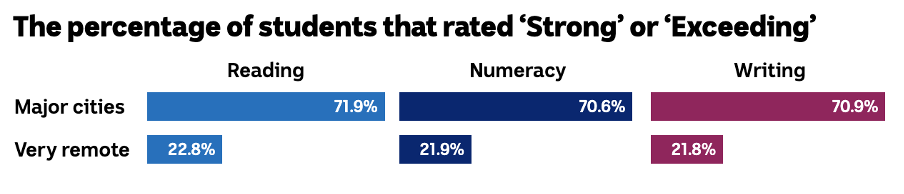
This represents a nearly 50-percentage point gap in achievement based solely on geography.
Such disparity cannot be addressed by curriculum reform alone. It demands a systemic response that prioritises equity in conditions for teaching and learning, particularly in regional and remote settings.
At the same time, there is encouraging data showing progress across various domains – a trend we absolutely want to sustain and scale as a sector and society.
But true progress must be inclusive. After all, we are in the business of improvement, not just performance. Our work should be driven by the supportive systems and structures that create the conditions where quality teaching, engaged learning and whole school wellbeing is the norm.
We can debate curriculum changes. We can advocate for explicit teaching, inquiry learning, phonics, or project-based approaches.
But I am tipping that a large number of people will see the value in creating the conditions for quality teaching and engaged learning – because if we don’t, we continue to see disparity across our schools.
Glenn Fahey, an education analyst from the Centre for Independent Studies, says that we’ve seen declines in student achievement despite significant investment in funding of school systems.
The call to action is to invest in creating the conditions for teachers to teach well and students to learn in ways that work for their development.
Learning doesn’t begin with prescribed lesson plans and accompanying power point slides. It begins with safety, trust and connection.
At Education Economy, our mission is: ‘Creating the conditions for quality teaching, engaged learning and whole school wellbeing.’ We aim to demonstrate that quality teaching and engaged learning doesn’t emerge in isolation. It’s built on a layered, human foundation.
What can we do differently knowing what we know about how students learn?
The neurobiology of learning reinforces that we cannot access working memory or higher-order thinking when we are stressed, disconnected or feeling unsafe. The amygdala hijacks the prefrontal cortex and suddenly long division or persuasive writing is the least of a students’ concerns, let alone the teachers.
We cannot explicitly-teach our way out of stress. We cannot curriculum-design our way out of disengagement.
We must, instead, create the conditions for quality teaching and engaged learning.
Bridging neurobiology, cognitive science and pedagogical practice to support quality teaching, engaged learning and whole-school wellbeing.
Behaviour encompasses mindset, motivation, readiness to engage and the capacity to build, deepen and apply knowledge.
Understanding how both staff and students behave is not about ‘managing’ either. It’s about creating the right conditions for learning to occur meaningfully and consistently, but also for teaching to occur at the highest quality.
Too often, we see the separation of academic improvement and behaviours. For example; we report via NAPLAN on Literacy and Numeracy across selected year levels but we don’t report nationally on student well-being, connection to school or their sense of belonging. Why is that?
Our focus is not on managing behaviour but on addressing the conditions that influence it.
We support schools in creating those conditions, regardless of the curriculum, the government of the day or the weather outside. At the core of our work is a preventative approach to teaching and learning adversity. By planning for what might go wrong, emotionally, behaviourally or contextually, we reduce the likelihood of breakdowns or disruptions.
And when challenges do arise, their impact is less severe and more manageable.
These ideas are discussed more deeply in my book ‘Disruption in Schools: Understand me before you mark me!’, which looks at responding to the daily realities of the classroom.
The 2025 NAPLAN results are a mirror, not just of student performance but of the system itself.
Behind every percentage point is a student with potential and a teacher doing their best in a context that may or may not support success. The conversation we need to have always had goes beyond test results.
It asks: What are we doing to create the conditions in which every learner and teacher can achieve?
We can no longer afford to separate wellbeing from achievement or environment from outcomes. As educators, leaders, parents and policymakers, we must treat learning not just as a cognitive exercise but as a human one.
If we are serious about closing the gap, not just in data, we must act with the same urgency and clarity with which we respond to academic decline. We must prioritise safety, connection, capability and belonging as foundational elements of any school improvement agenda.
This isn’t a soft approach. It’s a smart, evidence-informed strategy for long-term success.
The path forward is clear. Invest in the conditions.
And commit to a system where every student, regardless of postcode, has access not only to education but to the kind of education that meets them where they are and takes them further than they thought possible.
Let’s move from reaction to responsiveness.
And from performance to purpose.
By Ben Sacco
LinkedIn Article: Click here