
We Keep Renovating the Rooms. What About the House?
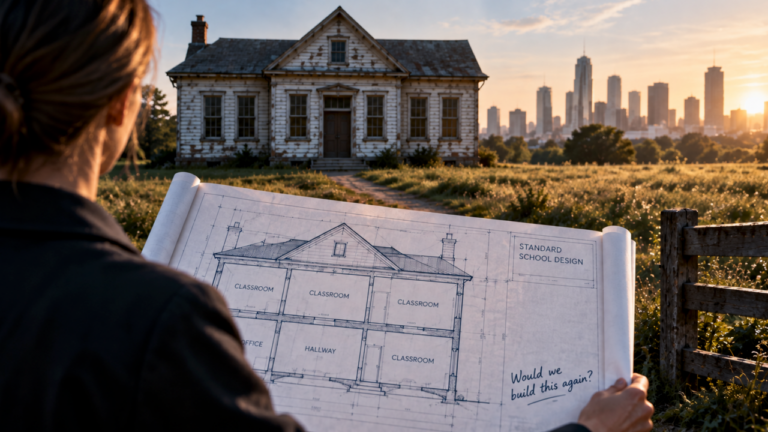
Reading Geoff Masters recently published book The Children We Leave Behind, has reinforced something I have been thinking about for some time.
Much of the education debate focuses on what we should change inside our schools: how teachers teach, what children learn, behaviour, technology, testing and so on.
What increasingly interests me is not just what happens inside the classroom but the design of the system around it.
We have become very good at renovating the rooms of education without asking whether we would build the same house today.
Much of what we call education reform is really ‘school reform’.
Governments and education systems try to change how teachers teach, what students learn, how behaviour is managed, how technology is used and how we measure whether children are succeeding.
Explicit teaching, behaviour programs, technology bans and new ways of testing and measuring learning are, in many ways, the furniture of the house. Some pieces are better than others. Some make the house more comfortable, orderly and functional. Some probably should have been thrown out years ago.
Yet furniture cannot correct architecture.
If the house was designed in another age, for another climate and another way of living, there is a limit to what can be achieved by continually rearranging what sits inside it.
A beautifully furnished room is still dark if the windows face the wrong direction. Better lighting might compensate for the absence of natural light. However, it does not resolve the design decision that created the problem in the first place.
Our education system faces a similar challenge.
We spend enormous amounts of energy debating what should happen inside classrooms without asking why schooling is organised as it is.
- Why do we group children primarily by age?
- Why do we expect them to learn within the same blocks of time?
- Why don’t teachers more often stay with the same group of students for more than one year (aka ‘looping’), allowing stronger relationships and a deeper understanding of how those children learn?
- Why, when a young person struggles within existing arrangements, is our response so often focused on what needs to change about the student, the teacher, the parent or the school before asking whether something about the way we have designed schooling might be contributing?
This is what I find so compelling about Masters’ work. Among many important arguments, he asks us to question some basic assumptions around how we have organised schooling and critically confront the human consequences when those arrangements do not work for everyone.
That is the part I keep coming back to.
When a young person disengages, falls progressively further behind or eventually finds themselves outside mainstream education altogether, it is tempting to see that outcome as an individual problem requiring an individual solution.
When similar patterns repeat across communities, generations and groups of young people, we should be prepared to ask more uncomfortable questions.
Are we looking at isolated failures within the system or are we seeing the consequences of the way the system itself has been designed? And if it is the latter, what are we prepared to do about it?
If some of the problems come from the way schooling itself is designed, there are limits to continually asking individual schools, teachers, students and families to make up for them.
Which brings me back to the house.
Education reform so often returns to the classroom because furniture is easier to move than walls.
Moving furniture is visible. It can be announced, implemented and measured. Governments can introduce a program. Education departments can mandate an approach. Schools can introduce a new framework.
Changing the structure of the house is different.
It requires us to question things we have done for so long that we can easily assume this is how school has to work, rather than recognising that many of these arrangements were choices made at particular points in history.
We are preparing children and young people for a world very different from the one in which many of those choices were made.
Technology is changing. Work is changing. The things young people will need to know and be able to do are changing. The paths they take through education, employment and life are becoming less linear.
Yet much of the architecture of schooling remains the same.
None of this means we should stop improving what happens inside classrooms. But we need to be willing to examine the house itself.
Who was it built for? Who can comfortably find their place within it? And, most importantly, who keeps finding themselves outside its doors?
At some point, reform requires more than deciding where the furniture should go.
It requires us to ask whether the house itself is still fit for the people we are asking to live in it.
The measure of an education system should not just be about how well it serves the children who successfully navigate it. It should also be how effectively it reduces the number of children it leaves behind.
By Ben Sacco
LinkedIn Article: Click here