
What is the absent story behind the data?

Todays’ Herald Sun article by Chief Education Reporter Rebecca Borg, titled “Victorian school absences surge as millions of days are lost to family holidays, unauthorised time off” is well worth the read.
It is also worth taking a closer look at the data.
We know that regular school attendance is strongly linked to academic achievement, wellbeing, social connection and long-term outcomes.
The data reported today is concerning.
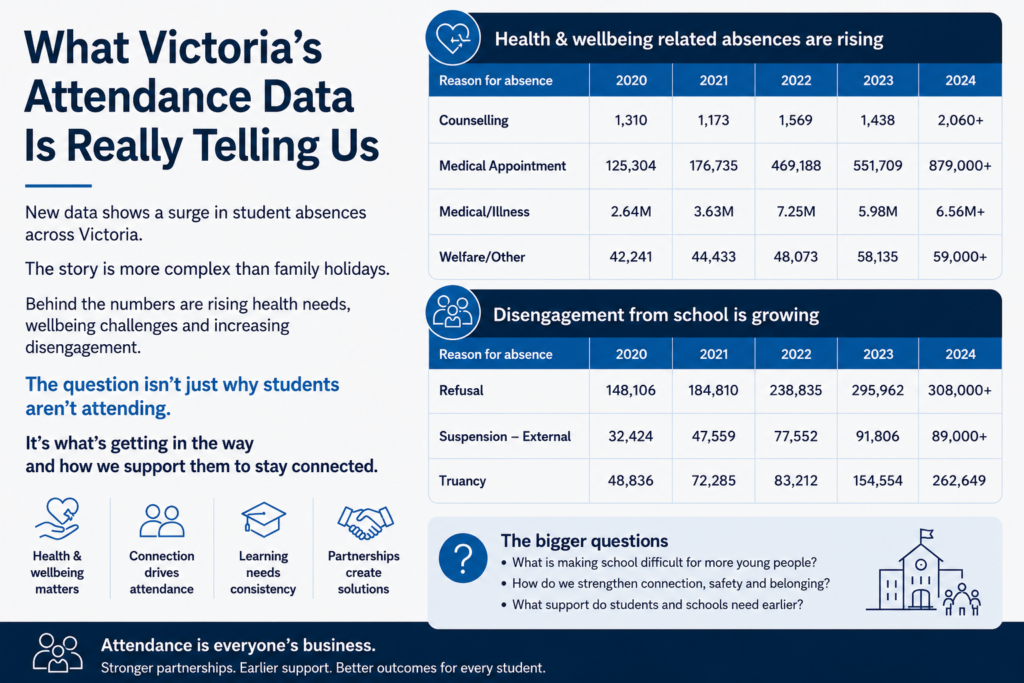
Public school students recorded more than 16 million absence days in 2024, with significant increases since 2020 – a pandemic year.
Take a look at some of the absence categories such as; counselling, medical appointment, welfare/other and medical/illness since 2020.
What stands out to me, is not simply that students are missing school.
It’s that there is a significant increase in health-related absences.
- Medical appointments have risen dramatically.
- Medical and illness absences remain extraordinarily high compared to pre-pandemic levels.
- Welfare-related absences continue to increase.
These trends suggest that many children and young people alongside their families are navigating increasingly complex health, wellbeing and support needs.
Other attendance categories to look at include; refusal, external suspension and truancy.
- School refusal has more than doubled since 2020, increasing from approximately 148,000 days to more than 308,000 days. Advocates often educate the wider community that the term “school refusal” may be misleading and that the context to be aware of is that, children and young people who experience severe mental, physical, emotional or social distress at school, essentially try to protect themselves and in doing so, not attending school presents as the best option available causing the least harm.
The suspension data is also significant.
- External suspensions increased dramatically following the pandemic years and remain substantially higher than 2020 levels. While suspension can sometimes be necessary to maintain safety, the data also raises important questions about whether schools are increasingly managing complex behaviour through exclusionary means or whether schools just do not have the resources available to adequately support students with complex needs even if they wanted too.
At a time where we are seeing a significant rise in health-related issues, we are also seeing a significant increase in suspensions. So is this an opportunity to talk about student engagement not just attendance?
We are seeing growing numbers of children and young people who are struggling to remain connected to school.
The challenge for education systems is to hold two truths at once:
- School attendance is critically important.
- Families, children and young people are facing increasing complexity that cannot be ignored.
If we want to improve attendance outcomes, the solution is unlikely to be found in blame. It will be found in stronger partnerships between schools and families, systems that support the development of preventative measures and structures that support those measures.
That does not mean expectations around attendance should be lowered. Attendance remains critically important. Students need access to learning, healthy routine, curriculum, relationships and the protective factors that schools provide.
However, if the public conversation focuses only on accountability, we risk missing what the data is telling us.
We should be designing systems and structures that address some of the following:
- What is making school difficult for increasing numbers of children and young people?
- Why are more students disengaging from learning and belonging?
- How do we strengthen relationships, safety and connection before absence patterns become entrenched?
- What support do educators need to respond to increasingly complex student needs?
Every child is at risk of disengagement the minute they walk through the school gate? And the same can be said for teachers.
By Ben Sacco
LinkedIn Article: Click here